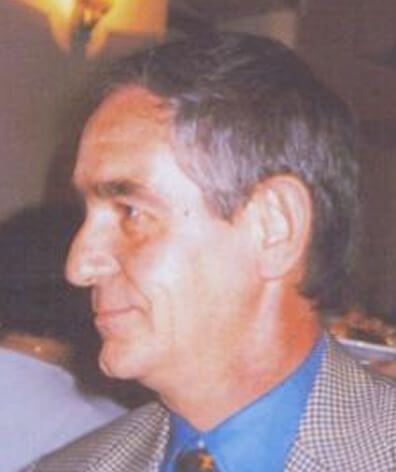
Liber Prim - X Duke of Piazza Pontida
Bruno Agazzi da June 1999 a June 2014
Unlike all his predecessors, who entered the Ducato through the main door, the tenth Duke entered through the service entrance, a path shaped by the events of his life, which I will briefly outline here.
After completing compulsory school, Bruno’s provident parents, wishing to provide their son with a trade, sent him to the Patronato of S. Vincenzo, a renowned workshop for skilled artisans and technicians, founded by Don Bepo Vavassori, who did far more for youth than all the Ministers of Education in Italy since the postwar period. Among the opportunities offered by the Patronato, Bruno chose the printing sector and, after obtaining his diploma, began his apprenticeship both in the trade and in life.
Meanwhile, under the reign of Duke Lodovico I, some financial difficulties arose, so much so that GIOPÌ had to suspend publication with issue 24 of June 14, 1964.
Thanks to the generous intervention of a few loyal supporters, including Vice Duke Dr. Giò Truffelli, Bigio Milesi (the unforgettable official mask), and a few other “saints” (literally), GIOPÌ resumed publication with issue 25 on November 1, 1964 (All Saints’ Day); however, the publication frequency was reduced from weekly to biweekly.
Seven years later, during Duke Esculapio I’s reign, two printers had already succeeded each other in printing the biweekly, and a third was needed. After a long search, Bruno Agazzi, a young man in his early thirties with three years of marital experience and four or five years of printing experience, who had recently set up his own printing workshop in an inner courtyard on Via S. Tomaso, was finally chosen. Agazzi enthusiastically accepted the task.
This was his first encounter with the Ducato, a “do ut des” motivated solely by work reasons, in which both parties, according to observers, may have been overly optimistic. Yet this optimism proved fully successful over the following thirty years, and to the surprise of the naysayers, he remains the official printer of GIOPÌ. That is why, at the beginning of these notes, I said Bruno Agazzi entered the Ducato through the service entrance.
Out of curiosity, I leafed through the first issue he printed. Would he remember it? Coincidentally, it was a very important issue in the history of the Ducato: a “special” double issue 11/12, dated June 30, 1971, to celebrate the 80th anniversary of our official organ, GIOPÌ. The occasion featured two editorials by Duke Esculapio I and editor Luigi Gnecchi on the front page, along with almost four columns of poetry throughout the issue, celebrating the anniversary, by prominent poets of the time: Amedeo Goglio of Piazza Brembana, lawyer Martino Vitali of Ciserano, G.B. Galizzi of San Gallo, Anna Rudelli of Casazza, and Nino Gioacchino Gambirasio of Bottanuco, of whom only the poetess survives today. There was also a report by Professor Vittorio Mora on the first 80 years of GIOPÌ, occupying more than two full pages, and another five pages were dedicated to a report by editor Luigi Gnecchi on the activity under Duke Esculapio. The only sad note in this celebration was a touching obituary, also written by Luigi Gnecchi, on the death of Giacinto Gambirasio, unforgettable poet and scholar of Bergamasque traditions, who passed away during those days.
From that moment, Bruno Agazzi gradually entered the life of the Ducato: he was named J.P. knight in October 1974 by Duke Esculapio I and, in 1992, inherited the demanding role of Treasurer, until, upon the death of Duke BRASCA Ü., the Ducal Senate, in solemn session on May 29, 1999, elected him by a large majority as the tenth Duke of Piazza Pontida, who took the ducal name LÌBER PRIM.
The long and steady involvement with the Ducato, which began as a simple work relationship, gradually transformed into an ever-growing passion for popular culture and traditions, which also engaged his spouse Primarosa, an effective and discreet collaborator, constantly at his side.
Bruno Agazzi thus prepared to embrace his new role as Duke, both in continuing traditional initiatives and in launching new projects. Among his first undertakings was the renewal of the newspaper, which he wanted in color edition, expanded and enriched with many new contributors and columns.
The most courageous and defining initiative was undoubtedly the almost-surprise launch, in 2000, of the National Festival and Award of Italian Poetry in Dialect: courageous, because poetry is a noble and ancient art, yet rarely attracts the masses and is often neglected, also due to limited economic returns; defining, however, because it reinforced the Ducato’s long-standing tradition in this field with the most vibrant and innovative examples from the national dialect poetry scene. For further details, see the essay by Gabrio Vitali, who conceived and curated the Festival and Award.
With LÌBER PRIM, another awaited initiative finally came to fruition the following year: the publication of the Italian-Bergamasco dictionary, complementing the one by Tiraboschi published in 1867. The work, the result of careful research by friends Carmelo Francia and Emanuele Gambarini, was presented to the public in the Provincial Administration council hall, in the presence of civic authorities, who expressed their sincere appreciation. The project was recently completed with the publication of the second part, covering the Bergamasco-Italian section.
The most striking initiative of LÌBER PRIM remains the surprise installation of a bronze statue of Arlecchino by sculptor Mario Gotti, weighing about five quintals, atop the fountain in Largo Rezzara on Fat Tuesday 2003. Passersby, amused and curious, gathered around, forming an applauding crowd ready to sign a petition, which by the end of the Mezza Quaresima celebrations had collected nearly six thousand signatures.
What began as a playful carnival stunt thus became, despite some challenges, a magnificent gift from the Ducato to the city.
The Duke and the Ducato have paid particular attention to “their” square, following its restoration closely and achieving, uniquely among civic associations, the installation of a large ducal emblem on the southwest corner of the pavement. For several years, the square has hosted the series of open-air shows titled “Summer Appointments under the Stars of Piazza Pontida.” Among these, one of the most successful initiatives has been the opera concerts: every year, one of the most famous works from our rich operatic tradition is performed, often in concert form. This is just one of the ways the association seeks to bring major cultural events out of elite spaces and into the public square.
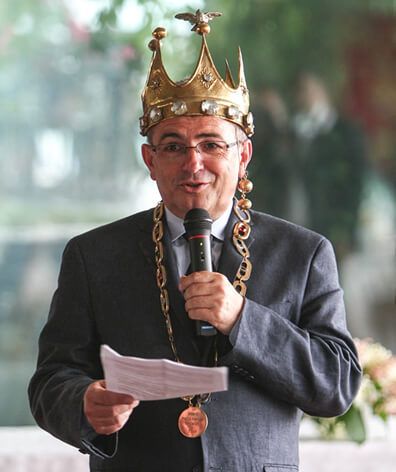
Finally, the annual meeting with city authorities at the New Year’s greetings, with their playful satirical tones, symbolically renews the Ducato’s ancient bond with the city and provincial leaders. Supported by a strong team of skilled, cohesive, and selfless collaborators, and drawing on over thirty years of experience, the Serene and Resounding Duke LÌBER PRIM continues to advance toward new, bright achievements, even leading the grand Mezza Quaresima procession on horseback with a touch of flair.
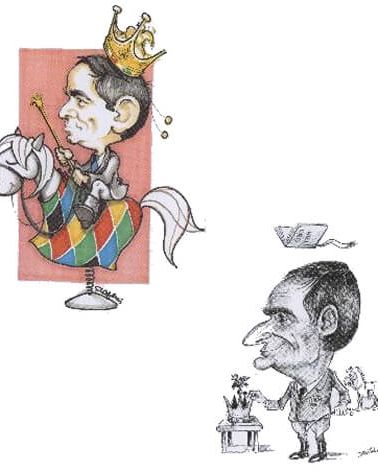
The caricature of the duke